# Treasury

## Overview

Bifrost’s on-chain treasury represents a paradigm shift in capital allocation and social organization, which supports and encourages anyone to collaborate around a common goal and promote the ecological construction of Bifrost.

The operation of the Treasury is mainly to absorb the value of use cases and continue to stimulate ecological growth in the form of BNC, forming a positive economic cycle. Anyone can apply for treasury funds through the **treasury proposal**. For the specific process, please refer to: Governance: The Treasury.

## Treasury Incomes

### Staking Liquid Protocol Fee

**Reward Fee**: The reward fee is drawn from the part of the underlying Token’s staking reward. (The vToken APY on Bifrost Dapp is the actual APY after deducting the reward fee.)

**Unstake Fee**: The unstake fee takes from the principle of the unstaking vToken amount.

(All these parameters below can be discussed and modified via Bifrost Governance)

| vToken | Reward Fee | Unstake Fee |
| ------ | ---------- | ----------- |
| vDOT   | 10%        | 0.1%        |
| vKSM   | 10%        | 0.1%        |
| vGLMR  | 10%        | 0.1%        |
| vMOVR  | 10%        | 0.1%        |
| vETH   | 10%        | 0.1%        |
| vFIL   | 10%        | 0.1%        |
| vBNC   | 10%        | 0.1%        |
| vASTR  | 10%        | 0.1%        |
| vMANTA | 10%        | 0.1%        |

### Liquid Crowdloan Protocol Fee

**Bond Convert Fee**: 0.01% of your vsBond principle

This fee happens once your vsBond is expired so that you can convert it to vsToken via Bond Convert.

### Transaction Fee

Approximated Fee:

> Due to the complexity of the calculation of the actual transaction fee on the chain, the actual estimated value below is only for reference and not an exact value.

| Chain            | Fee        |
| ---------------- | ---------- |
| Bifrost-Kusama   | 0.2000 BNC |
| Bifrost-Polkadot | 0.0060 BNC |

### System Staking Fee

What is system staking? Refers to [here](#system-staking).

## Treasury Expenditures

Each expenditure of the Treasury is necessarily to be passed via the Governance, there are some main cases to use the Treasury fund：

* Anti-risk, slash insurance
* Bifrost ecosystem grant
* System arbitrage
* BNC buyback
* Marketing & events
* Provide relevant trading pair liquidity
* and more...

{% hint style="info" %}
System Staking allows idle Bifrost tokens that have not participated in Staking to be cross-chain staked, thereby increasing the overall revenue of the protocol and vTokens.
{% endhint %}

## System Staking

### Principle of realization

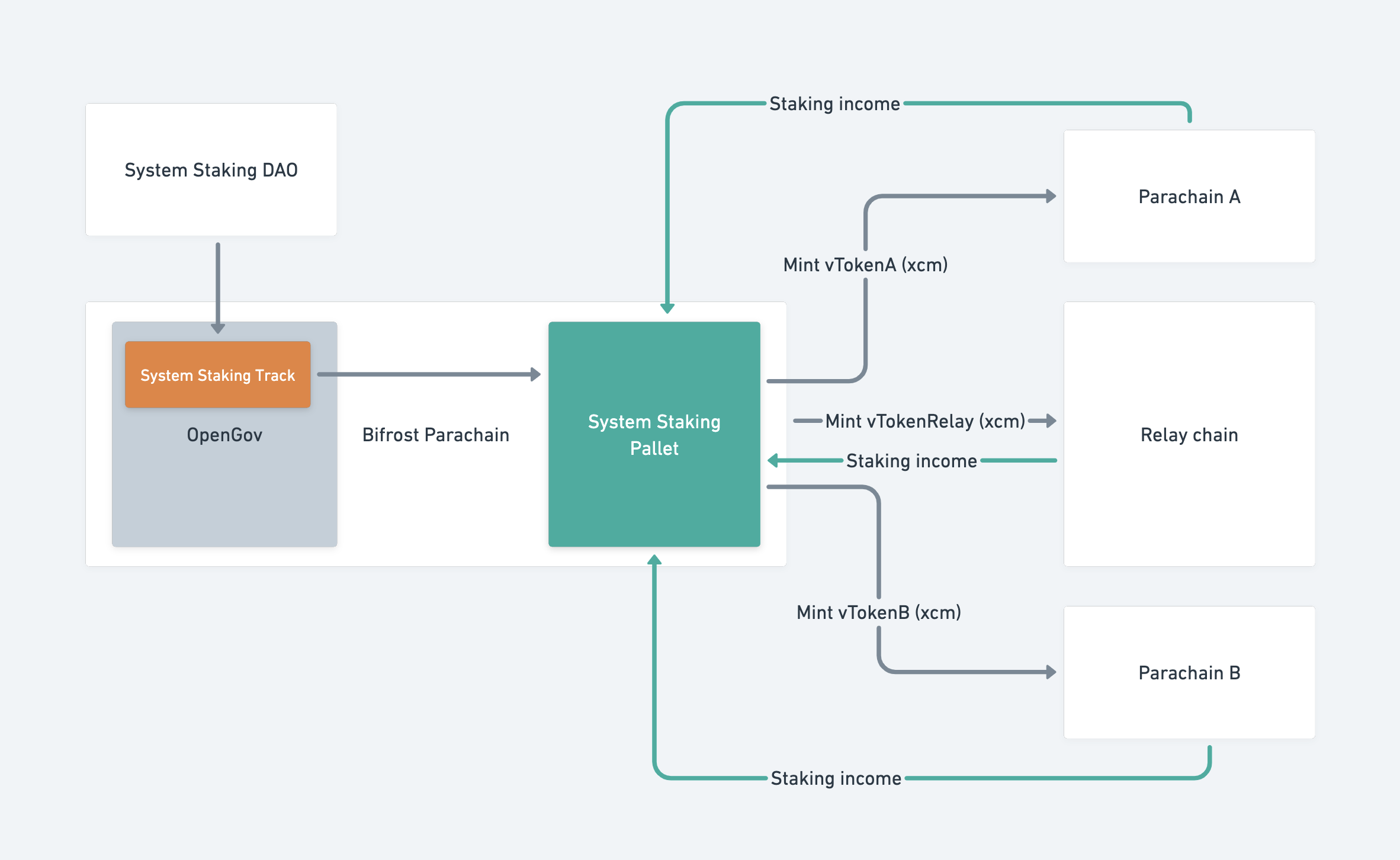
As a parachain of Polkadot & Kusama, Bifrost has secure and reliable XCM cross-chain interoperability capabilities. The Bifrost System Staking Pallet regularly mints tokens that meet the conditions as vTokens (refer to [SST Token Composition](#tokens-that-can-be-used-for-sst)) through the vToken Mint Pallet, and uses the parachain Pallet as the Operator (without private key) to initiate cross-chain Staking on the original chain, and distributes the Staking Rewards generated to vToken income, Bifrost Treasury, and veBNC (refer to [Income Distribution](#income-distribution)), thus achieving the effect of improving the overall utilization rate of funds for the parachain and users.

<figure><img src="https://757947912-files.gitbook.io/~/files/v0/b/gitbook-x-prod.appspot.com/o/spaces%2FJFtVsA5N3spWTWKvFvv0%2Fuploads%2FHDtohfEXnD3E1fYViKDL%2Fimage.png?alt=media&#x26;token=f2c8f906-07bf-4e30-a3cf-f3f34d922c42" alt=""><figcaption></figcaption></figure>

### Composition and Mechanism

#### System composition

The chain-level functional modules and decentralized governance DAO jointly form the basis for the operation and development of System Staking, mainly including the following parts:

| Part                  | Info                                                                                                                                                                                                                              |
| --------------------- | --------------------------------------------------------------------------------------------------------------------------------------------------------------------------------------------------------------------------------- |
| System Staking Pallet | The main chain-level functional logic module, which implements and operates the core logic of System Staking                                                                                                                      |
| System Staking Track  | Based on OpenGov, a referendum governance track specially designed for efficient governance to execute System Staking related management operations                                                                               |
| System Staking DAO    | Composed of core contributors and active members of the community, responsible for managing and initiating governance related to System Staking operations and continuously maintaining and updating the System Staking mechanism |

#### Operating mechanism

1. SST DAO statistics and evaluates the situation of idle assets on the chain, and initiates relevant configuration governance referendum on SST Track.
2. Bifrost community participates in SST Track governance referendum and passes it.
3. SST Pallet receives and executes the parameter configuration passed by the referendum.
4. SST automatically executes the corresponding chain logic, the main logic is:
   * Temporarily issue tokens according to the number of tokens that can be executed by SST.
   * Cast the temporarily issued tokens into vTokens.
   * Regularly execute Payout to distribute the extra value of vTokens to each module (refer to [Income Distribution](#income-distribution)).
   * When the number of available tokens of SST decreases, vTokens will be redeemed automatically as tokens, and the temporarily issued tokens will be destroyed to keep it equal to the SST setting value.

#### Tokens that can be used for SST

* Bifrost Treasury Token Reserve
* Bifrost Treasury LP Corresponding Token Reserve
* vToken Arbitrage Module Token Reserve
* SALP Token Buyback Reserve (for DOT and KSM)
* Token Deposited in Farming Pallet in the Long Term
* Token Reserve of the Parachain Sovereignty Address when Asset Reserve Risk is Low

#### Income Distribution

<table><thead><tr><th width="191">Item</th><th width="94.33333333333331">Ratio</th><th>Info</th></tr></thead><tbody><tr><td>Treasury</td><td>60%</td><td>This portion of the revenue will be entered into the Bifrost Treasury and homogenized with other treasury assets, and subsequent secondary distribution will be more reasonable and flexible through treasury governance</td></tr><tr><td>vToken MEV</td><td>20%</td><td>This portion of the revenue will be shared with all vToken holders by directly increasing the exchange rate of vToken-Token through the direct destruction of the corresponding revenue vToken</td></tr><tr><td>veBNC Incentive</td><td>20%</td><td>This part of the profits will be directly entered into the veBNC incentive pool, following the veBNC incentive distribution principle, and incentivizing long-term holders of BNC.</td></tr></tbody></table>

### Risk assessment

#### Risk points

#### Un-Staking Liquidation

System Staking Pallet will trigger an un-staking mechanism when the asset reserve risk increases, reducing the asset reserve risk. However, if there is a large-scale cross-out of Tokens from Bifrost parallel chain to the original chain or other parachains during the un-staking waiting period, it may be impossible to fully redeem the cross-out assets, resulting in user asset cross-chain failure.

#### vToken Slash

System Staking, as a vToken holder, will face the same slashing risk as other vToken holders. When slashing occurs, the SLP protocol will dispose of the slashing according to the risk disposal plan. However, when System Staking Pallet takes on the slashing risk, there may be a situation where the cross-chain assets cannot be fully redeemed, resulting in the user's cross-chain asset failure.

### Evaluation indicators

#### Asset Reserve Ratio

The reserve ratio excluding the controllable tokens held by the Bifrost Treasury & System, the calculation formula is:

{% hint style="info" %}
User Asset Reserve Ratio = Available Tokens in Bifrost parachain Address / (Total Issued Tokens of Bifrost parachain - SALP Redeem Pool Token Amount - Tokens Held by Bifrost Treasury & System)
{% endhint %}

#### Safety range

Based on risk control requirements, Bifrost defines corresponding risk levels and corresponding reserve rate parameters.

| Risk level | User Asset Reserve Rate |
| ---------- | ----------------------- |
| low        | > 90%                   |
| medium     | 60% - 90%               |
| high       | < 60%                   |

### Disposal plan

When the risk level increases, the community can initiate governance through SST Track, expend from the Bifrost Treasury to execute relevant risk handling, increase the reserve rate, and avoid squeeze-out. Based on different situations, risk handling can take many forms:

#### Issuing High-Interest Token Bond

System Staking Pallet issues discounted Token Bonds through high interest discounting to attract Tokens to enter and purchase Token Bonds, increasing the asset reserve rate.

#### Single token liquidity farming

Enable single token farming to attract tokens to enter liquidity farming and increase asset reserve rates.

#### vToken Minting Incentives

Start the vToken minting incentive to attract Tokens to enter the minting of vToken, providing liquidity for SST redemption and increasing asset reserve rate.

#### Short-term loan.

Initiating a short-term loan proposal through the Bifrost Treasury to fill the reserve gap for Tokens during the risk period, preventing a run on the bank.